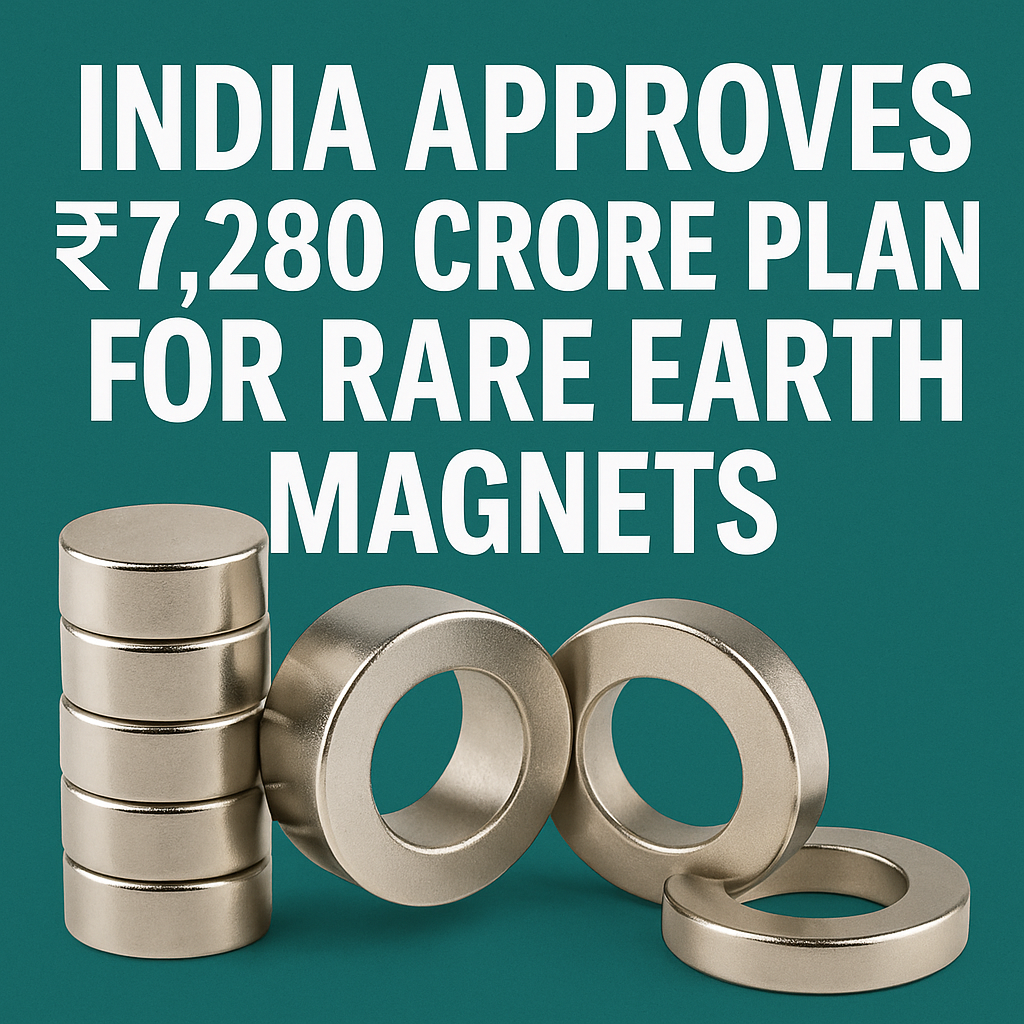
🇮🇳 India Approves ₹7,280 Crore Scheme for Rare-Earth Magnet Manufacturing
In a major step toward strategic self-reliance, the Union Cabinet of India — chaired by Narendra Modi — on 26 November 2025 approved a new flagship initiative: the Scheme to Promote Manufacturing of Sintered Rare Earth Permanent Magnets. Under this plan, the government will invest ₹7,280 crore to build a fully integrated domestic manufacturing ecosystem for permanent rare-earth magnets (REPMs). Press Information Bureau+2Business Standard+2
🔧 What the Scheme Entails
-
The aim is to create a production capacity of 6,000 metric tonnes per annum (MTPA) of sintered REPMs in India — a first-of-its-kind domestic supply chain. Business Standard+2PM India+2
-
The manufacturing will be “integrated”: starting from rare-earth oxides ➜ processed metals ➜ alloys ➜ and finally sintered permanent magnets, all under one roof. Press Information Bureau+2Business Standard+2
-
To build this capacity, the scheme includes ₹6,450 crore as sales-linked incentives over five years, plus ₹750 crore as capital subsidy for setting up the manufacturing units. mint+2The Financial Express+2
-
The plan envisions five manufacturing units, each potentially producing up to 1,200 MTPA, selected through a global competitive bidding process. The Economic Times+1
-
The total duration of the scheme is seven years: a two-year gestation period for setup, followed by five years of incentive-linked production. Business Standard+1
⚙️ Why REPMs Matter — The Strategic Importance
Rare-earth permanent magnets are among the strongest known magnets and are indispensable for a wide range of high-tech and strategic sectors, including:
-
Electric vehicles — powering motors and drivetrains Business Standard+1
-
Renewable energy — especially wind turbines and clean-energy systems requiring high-efficiency motors/generators Business Standard+1
-
Electronics — in devices needing compact, powerful magnets for efficiency and miniaturization Press Information Bureau+1
-
Aerospace and defence — for specialized motors, sensors, actuators, and other critical systems where performance and reliability are key. Press Information Bureau+1
Currently, most of India’s REPM requirements are met through imports — especially from countries dominating the global rare-earth supply chain. This scheme aims to drastically cut that dependence. Press Information Bureau+1
🎯 Strategic Goals Behind the Move
-
Self-reliance & Atmanirbhar Bharat: The scheme aligns with the broader national vision of reducing import dependence and building indigenous capacities in critical technologies. Press Information Bureau+1
-
Supply chain security: Given global volatility in critical-minerals supply (notably rare-earth elements), having domestic REPM manufacturing will insulate India from external shocks and export curbs from other countries. The Economic Times+1
-
Support to future-tech & green transition: With rising EV adoption and push for renewable energy, domestic REPM capacity ensures that India can meet future demand sustainably while advancing its climate and energy-transition goals. PM India+1
-
Economic & industrial growth: The scheme is expected to generate jobs, strengthen the industrial base, and spur growth in high-tech manufacturing sectors. Press Information Bureau+1
📰 Reaction & Industry Response
Industry stakeholders have welcomed the move. Leaders from the automotive sector — a major REPM consumer due to EVs — hailed this as a “significant step” toward resilient and stable supply chains for electrified vehicles. MotownIndia.com+1
Officials say that once operational, the domestic REPM ecosystem will reduce reliance on imports, cut costs, and increase competitiveness of India-made electric vehicles and high-tech products. Reuters+1
📈 What Lies Ahead & Challenges
While the scheme is ambitious, its success depends on several factors:
-
Efficient selection of capable players via global bidding — firms must ensure technology transfer, adherence to environmental and quality standards.
-
Execution within the planned timeframe (two-year gestation + five years incentive window). Delays or mismanagement could hamper momentum.
-
Ensuring raw material (rare-earth ore/oxide) supply, environmentally responsible processing, and sustainable practices — given ecological sensitivity around rare-earth mining.
-
Scaling up demand domestically to match the new supply capacity — EV adoption rates, industrial demand, export possibilities will influence long-term viability.
If all goes according to plan, India could emerge as a global hub for rare-earth magnet manufacturing, reducing strategic dependencies and fueling growth across multiple high-tech sectors.
What do you feel about this post?

Like

Love

Happy

Haha

Sad